Community Affairs

Santa’s Grotto in Kippen

Santa’s Grotto was started last year by the Lamb family in the garden of their house in Kippen. The aim was to raise funds for Start-up Stirling. These funds were to help give people in need a happier Christmas.

With the help of their many volunteer elves they managed to raise £525 in the first year. This year, the hardworking elves saw the total rise to £725. This was split between Start-up Stirling and ‘The Uniform Bank’ in Stirlingshire, an organisation who try supply children with cosy jackets and school uniforms if needed.Issue #1 - Santa Grotto -  IMG_0260.JPG
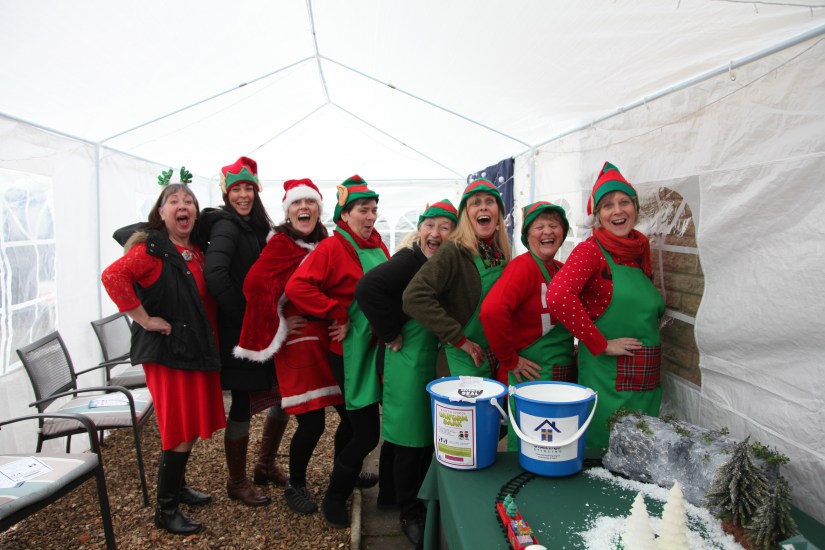
The Lamb’s transform their garden with a variety of floodlights and fairy lights. The addition of wooden reindeer, sleighs for photo opportunities for the children and a fairy light trail add to the atmosphere for the young and old alike. There is also an area, growing year by year, for a fairy village. There was also a model train for the children to play with allowing the adults to enjoy the social occasion. Young and not so young children also had the opportunity to have their faces painted by the elves.

The summerhouse was transformed into a colourful grotto where the children had the chance to talk with Santa, enjoy stories and receive gifts. Adults had the opportunity to photograph this visit to have some everlasting memories. The idea is for the children to have relaxed quality time with Santa.

Issue #1 - Santa Grotto -  IMG_0301.JPGAll moneys raised were through the sale of baking and a raffle. Mulled wine both with or without alcohol and soup were also available and all were encouraged to donate. All items were donated by many generous businesses and friends of the Lamb’s from Kippen and surrounding areas.

The family would like to take this opportunity to thank all who gave their time and services to help and support this event. We intend making this an annual event and hope next year it can grow further and we can raise our total again.

Shirley Lamb

Did You Know

Cardross-Masai Mara connection

Some of you will have been on a safari holiday, maybe to Kenya and its famous Masai Mara National Reserve. But you will perhaps be surprised to learn that the maps and guides currently used in the “Mara” originate in Scotland, and specifically with David and Rosemary Watson, who last June moved into a flat at Cardross House. The story is unusual. Both are Geography graduates, who met as postgraduate students in Uganda, over 50 years ago. On their return to Scotland, David became an orienteer, in the Scottish team, and during his 20s and 30s an avid orienteering-map-maker.

Fast-forward 30 or 40 years to 1999, and the Watsons were in Kenya’s Masai Mara, where, despite David’s “super-navigator” orienteering experience, they managed to get lost. And naturally, David blamed the inadequate maps. On returning to Nairobi, the following week, David visited the Kenya Wildlife Service, offering to help upgrade the survey of their reserves, and to his great surprise, was offered 5 national parks to map. Undaunted, and with virtually no resources, he set to, starting with nearby Nairobi National Park and the rest, as they say, is history.

Issue #1 - Little Governors 7.jpg17 years on, and David has mapped numerous national parks, in Kenya and Tanzania, and has written a range of travel books and guides. For some years, he was the East African writer for Thomas Cook. Now he concentrates on the Masai Mara, one of the world’s most iconic wildlife areas, especially famous for its annual migrations of wildebeest. He and Rosemary combine as a team, David – the map-surveys, the writing and much of the photography, with Rosemary – graphics and design, and some photography, especially of birds. In the Masai Mara, their publishing company, Photoprint Scotland, produces an atlas of the ecosystem, conventional maps and an official guide. Currently they are working on a new official guide to the Masai Mara National Reserve, to be published at the end of 2017.
Which goes to show, getting lost can turn out to be one of life’s most positive experiences.

David Watson

Did You Know

Anyone For Cards?

Contract bridge? I believe that there is a mythology surrounding the game that strikes fear into the uninitiated. Have no fear – it is simply whist with bells on. And there is a group (club would be far too grand a claim) that meets every Thursday at 8pm in the Cross Keys. We are largely self taught, and keep it very simple and social.

As to the game itself, the card play is the identical to whist. The bells on aspect refers to the auction which generates the final contract to be made.

Let me explain briefly. The cards having been dealt, each player assesses the strength of their hand and then through the auction process tries to communicate to their partner the nature of their hand. As each bid must be of higher value than the previous, the task of achieving the contract becomes more onerous. In exchange for information you are expected to work harder to make your contract. This transforms whist from just playing the cards you have got with trump suit being in a fixed sequence, to determining the suit that you wish to play in and the number of tricks you intend to win. Of course, you don’t have it all your own way with the opposing pair having a desire to set the trump suit to suit them.

There are many bidding systems that may be used by bridge players to communicate with each other. Some are indeed very complicated but we keep to a very simple but effective system. Strangely, in my eyes, you declare your system to your opponents. Take as much or as little interest in the opposition’s system as you like! Well that is my level of competence so far.

We do have our resident guru, Stuart Thomson, with decades of experience to point us in the right direction. So there is someone with actual expertise to develop our play. Others might be talking out of any convenient orifice.

In recent months we have even ventured out to play competitive matches in Edinburgh and Glasgow and acquitted ourselves well. So we are competitive (otherwise what’s the point?), but primarily social. It’s only a game of cards. It is meant to be fun. So, if you fancy an evening out these long winter nights, pop along to the Cross Keys at 8pm and the members of the Cross Keys Bridge Loose Association of People will make you most welcome.

Issue #1 - Bridge - DSCN1514.JPG

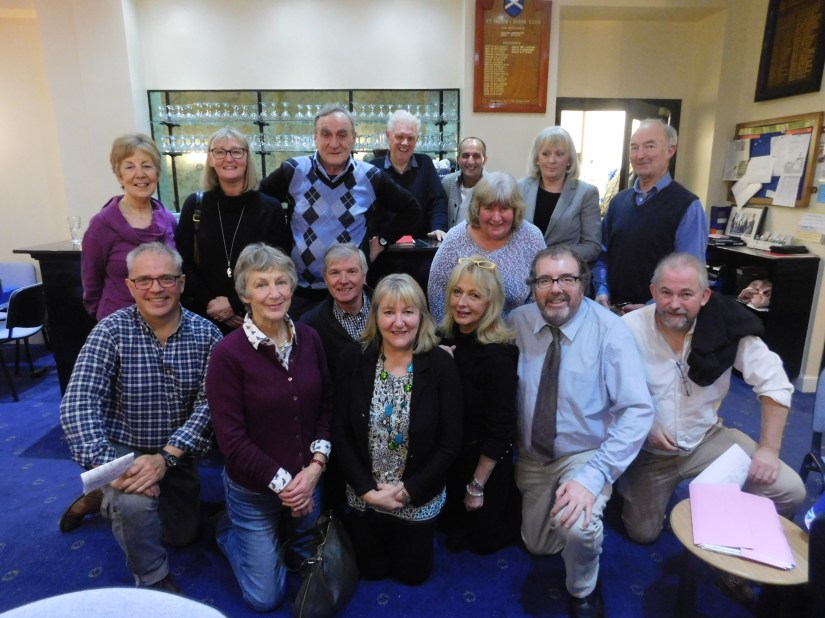
The accompanying photograph shows members of our club at a recent competitive outing at the St Andrew Bridge Club in Glasgow with members from that club and from the Glasgow Bridge Club, where myself and Sean Kelly had the good fortune (or skill?) to win our section.

George Finlay

Did You Know

Kippen Heritage

I hope we all know that Kippen is a special place to live. We are surrounded by breathtaking scenery and wrapped in a blanket of “community” not always found elsewhere. Kippen is however more than pretty houses and scenery, its special identity also comes from the legacy of those who lived here before us – we are temporary residents only. That legacy must be preserved and remain available to the generations who come after us and that is Kippen Heritage’s prime objective.

Kippen Heritage has developed from an original idea by Winnie Dunlop, not born and bred in Kippen but the next best thing – she married a “Kippenite”.

Over many years, from her keen interest in Kippen past and present, and her hard work, she has gathered a huge archive of materials charting the history of those who lived and those who still live in Kippen.

As Honorary President, she leads Kippen Heritage in its endeavour to preserve and disseminate that knowledge. To date, much of that archive has been successfully digitalised and in future this will be enlarged to be incorporated into a Kippen Heritage website available to all.

In addition, in the last year Kippen Heritage has worked successfully with the National Trust for Scotland to restore and reopen the unique Kippen Smiddy. The Smiddy is opening in 2017 on the following dates: Street Fayre day 10 June, Flower Show Weekend 19/ 20 August, Stirling Doors Open Weekend 16/ 17 September

We have a new Kippen postcard and a new mug designed by Margaret Oswald available for sale in local shops plus a Heritage Trail is being developed for 2017.

Margaret Diamond, Chairman Kippen Herritage

Did You Know

Kippen Smiddy

After many years of lying derelict, the 200-year-old Kippen Smiddy will open again to the public this summer.

Due to the efforts of Kippen Heritage, the National Trust for Scotland (who own it) were persuaded to carry out some repairs and maintenance to improve the conditions to allow access to visitors.

In the centre of the village near the Cross, the Smiddy sits at the top of Rennie’s Loan. This narrow-cobbled street was once Kippen’ s main road between Stirling and Dumbarton, which makes perfect sense for the site of a blacksmith’s workshop. The Smiddy was at the heart of village life and was owned by the Rennie family for at least six generations. Andrew Rennie, the last of that long line of smiths, was apprenticed to his father at the age of fourteen and he worked there until he donated it to the National Trust for Scotland in 1985, when he was in his 90’s.

In an interview, he recalled that there used to be a queue of horses outside the Smiddy every day waiting to be shod. Farming life relied on the Blacksmith also for ploughs and general agricultural tools. A few yards down the road sits the Black Bull House, originally the village inn built in 1729. Travellers would stop there for refreshment and have their horses shod at the Smiddy.

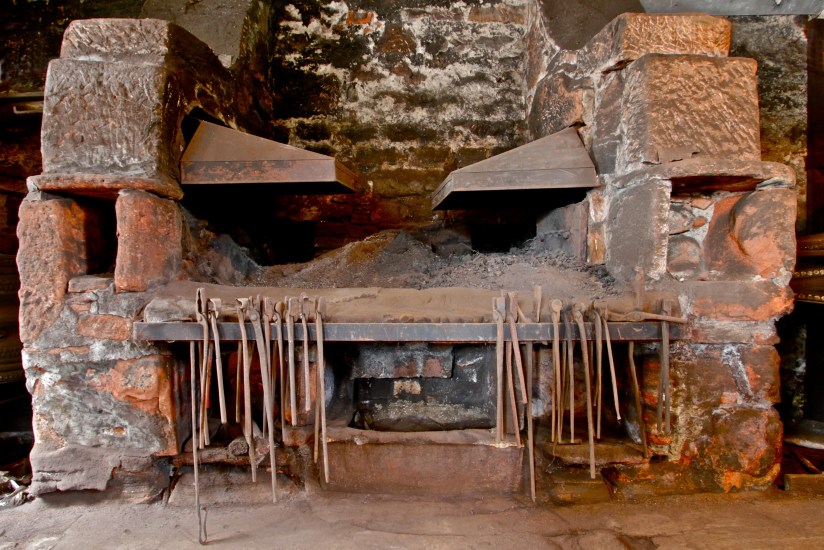
Stepping through the door of the Smiddy is like a step back in time. The old stone walls and floor still carry the traces of soot from the great double forge, while the large leather bellows sit either side of it, waiting to blow life into the fire. The double anvils in front of the hearth, tools still hanging around the walls and a turning lathe driven by a foot pedal all speak of days long gone.

Issue #1 - Smiddy - IMG_6396_2R.jpgA photograph of the hearth has kindly been supplied by Andrew Tweedie of National Trust for Scotland.
Kippen Heritage, acting as volunteers, hope to open the Smiddy again to the public next summer, so that people can once again step into this precious time capsule of a by-gone age.

Margaret Oswald, Kippen Heritage

Did You Know

Geese over Kippen

The ringing calls of geese have been a constant feature in Kippen this winter as large skeins fly over the village to feed in nearby fields. But would you be able to tell what type of geese they are?_

Truth be told, it can be quite difficult, unless you’re good at identifying calls. Often you only see them when they’re flying, or when they’re a bit of a distance away on the ground. Get too close, and they’ll rise up en mass in a whirl of dark wings._

But there are really only five species of geese that commonly winter in Scotland, and only four that you stand a chance of seeing in this area._

Overwhelmingly, the huge flocks on the Carse of Stirling are pink-footed geese. These are medium-sized geese that make a high-pitched ‘wink-wink’ call, and migrate here all the way from Iceland and Greenland._

Mixed in with them, you can sometimes see just one or two barnacle geese. These are smaller birds which are a distinctive black, white and grey, and have a rather yappy call. Much bigger flocks of barnacle geese can be found on the Solway and the Inner Hebrides._

Further to the west, you might also see some greylag geese, the largest wild goose in Scotland. These are lighter in colour than the pink-foots, with an orange bill and quite a harsh, squeaky call.

But over into the National Park, you might be lucky enough to see some of our rarer local geese, the Greenland white-front, so named because of a white patch around its beak. These have suffered a real fall in numbers in recent years, and in fact, they’re now a red-listed bird, which means they’re a species of conservation concern._

Jenny Tweedie

Did You Know

Going Fishing?

Walk, cycle or drive two miles up the Fintry Road and just before the Firs plantation you come face to face with one of the most idyllic sights in the district – Loch Laggan.

Nestling in a shallow basin and surrounded on three sides by established conifers, Loch Laggan, which formerly supplied water power to the Broich Mill, now has a purely recreational function, and is the base for Loch Laggan Fly Fishing Club.

Part of Garden Estate, the fishing’s were first leased from Martimas 1974 and stocked with 200 Rainbow trout in the spring of 1975, of which 150 had been accounted for when the first AGM was held in the Fintry Inn on 7th October 1975, and in the presence of 20 members, Mr. Ian Cooper was elected as the first President.

In subsequent years a mixture of Rainbow and Brown trout were stocked to join a resident population of perch; the latter being kept in check by intermittent trapping or fishing. The practice of mixing Rainbow and Brown Trout in the same loch was deemed to be disadvantageous and for a period only Brown Trout were stocked, 500 in 1978 plus 20,000 snails to provide feeding; an exercise not repeated since the loch was operated on a put and take basis and the residence time of the fish was relatively short.

In 1980 membership was increased to 50, and 1,000 Rainbow trout were stocked in a phased manner to even out catch records over the season.

During the 1980s, the club tended to be based in Kippen with a good number of Kippen residents as members and committee members. A new boathouse was commissioned and built, the number of boats increased to 4 and the membership to 60 and remains so.

Today some 1,800 Rainbow Trout at an average weight of 2lb. are introduced over the season which extends from 1st April to 31st October, with a catch limit of 3 fish per rod.

The number of members from the village has declined in recent years, and the membership is widespread including a good contingent from Helensburgh. A sign of the health of the club is the long waiting list for membership.

In addition the fishing, a visit to Loch Laggan can be rewarded by sightings of a variety of wildlife which includes duck, geese, swans and ospreys in season, plus roe deer, buzzards, heron and even an occasional otter and the inevitable cormorants.

As custodians of this facility the members of the club maintain high standards of conduct, and can introduce guests on a one for one basis, but there is no facility for the issue of day tickets to unaccompanied visitors.

Bob Mitchell

Did You Know

Size Does Matter!

We are often subjected to all those videos of cute piglets and many shout “I want one!” But, WAIT… have you done your research? Those tiny piglets do grow up and some can weigh 18 stone… even 48 stone… I know… I have 2!

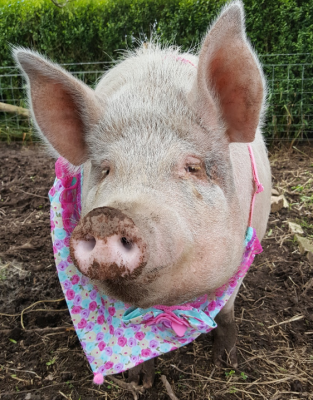
Issue #1 - Size does Matter - resized.pngI often post cute or funny pigtures on Facebook but, remember, it is just a moment… it is like owning 2 toddlers (except for the size but definitely the mentality). They are very inquisitive about everything and anything so when they are left unattended, outside their paddock, I always expect to find total destruction on my return… fences, buckets, anything not pinned down! They are very smart so if you don’t have their area secure…. They WILL find a way out!
No-one advised me at the time that if you get a female pig you should have them spayed… I am paying the penalty of that one… on a monthly basis. At 48 stone, Tammy Swinette can still outrun me on her hunt for boyfriend material!

The positives about owning a pig is their intelligence and willingness to learn… At 4 month’s old I taught Wilma (pot belly) to sit, give kisses, shut gates, play “Bang! You’re Dead!” and obviously how to ride a skateboard. Now at 18 stone she has retired from skateboarding, but still sits and plays dead (although takes longer to get back up… I know that feeling).

All in all, pigs are great pets if you have the space, however I wouldn’t recommend keeping them in the house like the craze that is sweeping America… they like to root, they like dirt, they like their own space… can’t imagine keeping a couple of bulldozers parked in my living room… well actually, if you know me, I could!

Ali Thom, Arnbeg

Did You Know

Kippen Old Churchyard

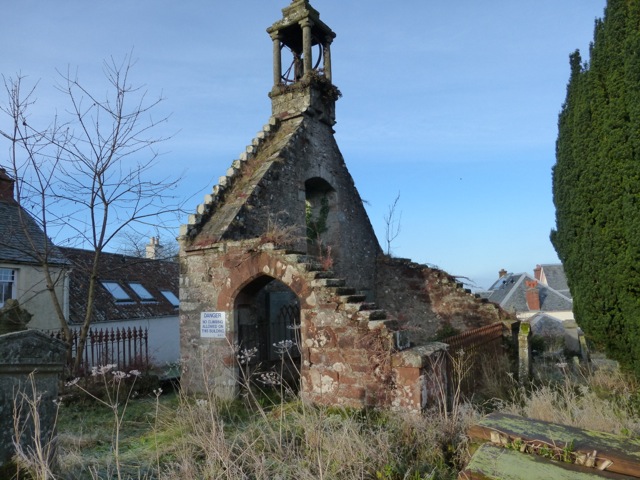
For several years, our old churchyard and ruined remains of the church, with its iconic belfry, have not been maintained. Ivy is growing on the gable wall of the church and vegetation has become rooted in the joints, thereby jeopardising the stability of the stonework. The boundary walls in places are also clad in ivy which, though attractive, can also be damaging. Self seeded trees are pushing through between the headstones and in one case a mature tree has destroyed the corner of a grave enclosure and dislodged the adjacent table gravestone. In some areas brambles are so dense that it is impossible to access the gravestones.

The graveyard does have visitors, many come from overseas to trace family origins, and there are some fascinating stones and stories to tell within the inscriptions. It is apparent that something ought to be done to rectify the situation and make the graveyard a place where locals and visitors can spend a few reflective moments.

However, it is hoped that the situation can soon be remedied and some initial work has already been carried out in this respect. Barbara Docherty, the Council Cemeteries Officer has been most helpful in giving advice and, should the community commit to raising sufficient funds to restore the remains of the kirk, the Council would offer assistance by way of ensuring the gravestones are stable.

Murray Cook, the Council Archaeologist, has also been very encouraging and supportive, suggesting that a group is formed to spend initially one weekend, perhaps in February, to work with a team of Council rangers to clear the destructive growth such as brambles, saplings and ivy from the stones and boundary walls. This will enable a full survey of gravestones to be carried out as there appears to be no record of inscriptions after 1855 when civil registration began.

Eventually it is hoped that the graveyard can be freely accessed and in view of the work which has already been instigated at the Old Smiddy by Kippen Heritage, the old churchyard could also be included in an historical ‘village trail’ accompanied by a publication which would assist, among other things, in locating burials and identify some of the more ‘celebrated’ occupants!

Quotations to carry out stone repairs to the ruin have already been sought together with costs for the replacement of damaged ironwork and it is also intended to seek advice and costs regarding restoration of the bell. But until the debris is cleared from the boundary walls, a full assessment of the work involved in the grounds of the graveyard cannot be carried out.

However, costs for the works to the ruin alone do not appear to be excessive and if money can be raised locally the need to apply for funding from such organisations as Historic Scotland may not be necessary initially. In this event the work not only can proceed much more quickly but, in view of efforts already made by the community, can assist in any application for match funding which may become necessary in the future.

issue-1-kippen-old-kirk

The Community Council, Friends of Kippen Kirk Trust and Kippen Heritage have all offered their support for the project. Currently, confirmation is awaited from the Kirk Session regarding ownership of the ruin but hopefully further notice can be given in the New Year regarding progress.

Anyone interested in helping in any way can be given an opportunity to take part, whether by joining a group to clear vegetation, fund raising or donating. Any assistance will be most welcome.

Irene Chapman
irene.chapman@mac.com

Did You Know

Kippen Vista Club

No, nothing to do with Cuban music and mystical hairy dictators, but an informal walking club.

The aim is to walk the vista as seen from Kippen, loosely based on the engraving at the view point at the top of Scott Brae. It is just about getting out and enjoying the stunning scenery on our doorstep and, as you can also see the Gargunnock Hills from Kippen, why not include them?

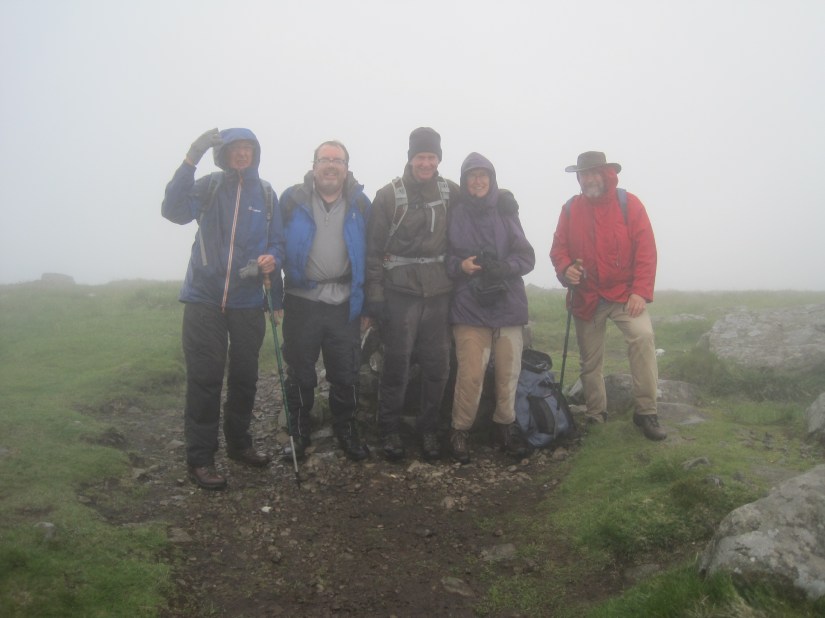
Issue #1 - 16-06-19 Ben Cleuch.jpgNo previous experience is required just a pair of good boots and a stout heart. The specific hill is chosen to suite the walkers and weather. For instance, recently (18th December) we went up above Braeval to the Trig point on the Menteith Hills. A short(ish) walk on a misty day, to suit those who had been out supporting OldPlay in the Cross Keys all night! Which brings me perfectly to identifying our “Club House” – aka Cross Keys. Hills are often selected over a Friday teatime pint, and on occasion it is important to “assess the day” on the way home.

issue-1-vistaCommunication has so far been mainly by word of mouth, but we are looking at setting up a Gmail account to allow coordination. There is also a facebook group here you can join. In the meantime, if you wish to be kept informed just email me at ptr.singleton@tesco.net.

Peter Singleton